Introduction
Budapest is becoming an increasingly attractive destination for digital nomads and remote workers who want to combine work, travel and everyday life in a European capital.
Whether someone comes to Budapest for a few days, a few weeks or several months, where they work can make a real difference. An apartment or café may be convenient occasionally, but regular remote work requires reliable internet, a comfortable workstation, a suitable environment for online meetings and, for many people, a professional community.
Coworking spaces can provide all of this without the commitment of a traditional office.
At Liftoff Coworking, in Budapest’s District VI, we encounter this international community every day. Based on our own billing and enquiry data, since the beginning of 2025 we have welcomed clients and enquiries associated with 27 different foreign countries.
In this guide, we share what we have learned from Budapest’s coworking scene: who uses these spaces, what digital nomads should look for when choosing a coworking space, and how coworking can make remote work in Budapest easier and more connected.
1. Is Budapest a good choice for digital nomads?
Budapest has become increasingly visible among international remote workers and digital nomads in recent years. This is due not only to what the city itself offers, but also to the fact that in 2022 Hungary introduced a dedicated residence permit for digital nomads from outside the EU/EEA, known as the White Card.
However, the White Card provides only a partial picture of the digital nomads spending time in Budapest. EU/EEA citizens do not need such a permit, and remote workers who spend only a short period in Hungary do not necessarily appear in these statistics either.
Coworking spaces therefore encounter a much broader and more diverse international community.
Our own experience at Liftoff reflects this. Since the beginning of 2025, 27 different foreign countries have appeared in our billing and enquiry data. We have received clients or enquiries associated with the United States, the United Arab Emirates and Israel, as well as the United Kingdom, Germany, France, Italy, Spain, the Netherlands and Ireland. Among Central and Eastern European countries, our data includes Poland, the Czech Republic, Slovakia, Romania, Ukraine and Estonia, as well as Georgia, Armenia and Azerbaijan.
It is important to note that this is not a nationality statistic. Our data is based on billing addresses and information we receive through conversations with clients and prospective clients. It does, however, illustrate just how international Budapest’s coworking environment has become.
2. Who works in Budapest coworking spaces?
Coworking today is about far more than freelancers and startup founders.
The Coworking Hungary 2026 national survey identified 51 coworking spaces in Hungary, as well as 58 serviced-office locations operated by 13 providers. According to the survey, IT, marketing and creative professions are strongly represented in coworking communities, while consultants and professionals in helping professions also use these spaces.
Remote employees and small company teams are also becoming an increasingly important group. In other words, coworking is becoming less tied to a single form of work: a freelancer, an entrepreneur building their own business, a remote employee of an international company and a small team may all work side by side in the same space.
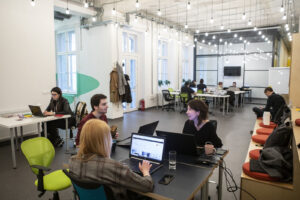
We see the same diversity at Liftoff. People working in IT, marketing, graphic design and other creative fields, consulting, sales and a variety of knowledge-based services work here. Some live in Budapest, while others are only in the city temporarily.
And this diversity is one of the most interesting aspects of coworking: people from different countries, professions and stages of life work alongside one another, even though they might never meet in a traditional workplace.
3. Where should you choose a coworking space in Budapest?
Location is particularly important when a digital nomad is choosing a coworking space. If someone is spending only a few weeks or months in Budapest, they usually do not want to spend a significant part of the day commuting, and it is useful if their workplace is easy to reach from different parts of the city.
Liftoff is located in Budapest’s District VI, close to Nyugati railway station. It is easy to reach by public transport, and many parts of central Budapest are within walking distance.
A central location is also practical for people who want not only to work in Budapest but to experience the city as well. After work, there is no need to travel back into town from an outlying office park: restaurants, cafés, shops and city life are just minutes away. During festival season, for example around the time of Sziget, we always see more visitors who work hard during the day and party hard at night — combining business with pleasure.
4. Can you use a coworking space in Budapest for just one day?
Yes. Flexibility is one of the main advantages of coworking.
At Liftoff, you can work with a day pass, so there is no need to purchase a long-term membership. This is particularly practical for someone spending only a few days in Budapest, someone who needs a reliable workplace between trips, or anyone who simply wants to try coworking before deciding on a longer stay.
Multi-entry and longer-term coworking memberships are also available for people staying in Budapest for longer.
Digital nomads have very different travel patterns: some move to a new city every few days, while others settle in one place for a month or more. That is why flexibility can be just as important as the workstation itself.
5. What should you look for when choosing a coworking space?
Fast, reliable Wi-Fi is essential, but regular remote work requires more than that.
A comfortable working environment, somewhere suitable for online meetings, and the ability to spend a full working day in one place without constantly searching for somewhere new all matter.
At Liftoff, standing desks are available, as well as a dedicated LIFT booth for online meetings and Zoom calls. Coffee and tea are included with coworking use, and we can also help members by receiving packages and mail. Because we are right in the city centre, we are always happy to recommend reliable places to eat nearby. Our neighbourhood is part of the area known as the Pest Broadway, with its theatres and international restaurant scene, and is one of the city’s liveliest districts.
The coworking space is dog-friendly, so people living or travelling in Budapest with a dog do not necessarily have to choose between work and spending time with their pet.
But there is one thing a list of amenities cannot easily show: the people around you while you work.
6. Why does community matter when you work remotely?
Remote work offers a great deal of freedom, but it has a less visible side too: it can be isolating. This can be particularly noticeable when someone arrives in a new city where they know very few people.
A coworking space can therefore be more than a workplace; it can also provide an environment that you can become part of from your very first day.
At Liftoff, we pay conscious attention to this. Our hosts are freelancers and entrepreneurs working in a variety of fields: among them are a marketer, a graphic designer, a coach, a sports professional and a book author. This means that we all know the independent and location-flexible way of working from personal experience.
For us, community is not a separate service or a networking event held once a month. It grows much more naturally from different people working in the same space day after day.
Conversations begin, people share professional experience, recommend services or places in Budapest to one another, exchange ideas, and sometimes business collaborations emerge.
For a digital nomad who has just arrived in Budapest, this can be especially valuable: they do not have to start building local connections entirely on their own.
7. The role of coworking is changing as work itself changes
We believe coworking is not only about where we work, but increasingly about how we work.
The boundaries between traditional employment, remote work, freelancing, entrepreneurship and project-based work are becoming less rigid. Over the course of a career, a person may move between several of these forms of work — and may change countries or cities along the way.
The spread of AI may accelerate this change further. People may be able to create independent services or businesses that would previously have required the resources of a larger organisation. For others, AI may create a need to rethink their profession, their knowledge or the value they can create.
During these periods of transition, a coworking community can be particularly valuable. Someone changing careers, starting a business, looking for a new professional direction or simply trying to work out what comes next does not have to face these questions alone.
They can meet people going through similar changes, find inspiration, discover potential collaborators, or simply talk to someone who understands that stage of life.
For this reason, we do not see the digital nomad lifestyle simply as “more people travelling with laptops”. It is part of a much broader shift: for more and more people, work is becoming separable from belonging to a particular company, office or even country.
8. Coworking in a former elevator factory
Liftoff’s location also has a connection to Budapest’s industrial history.
The coworking space is located in the building of the former Anton Freissler elevator factory. The elevators for the Hungarian Parliament Building were made in this factory.
Today, the same building is home to people working with digital technology, online businesses, media, design, consulting and other modern knowledge-based professions.
Innovation actually moved into this building long before we did. In a place where people once worked on one of the important innovative technologies of their time, digital entrepreneurs, remote workers and creative professionals now work with the new technologies and working methods of ours.
9. Who is coworking in Budapest for?
Coworking can be a good option for anyone working remotely in Budapest who does not want to spend the entire day in an apartment or café. It is worth trying whether you are in the city for just a few days or settling in for several weeks or months.
A good coworking space provides more than a desk, Wi-Fi and a working environment. It can also help you connect with people more quickly in a new city while preserving the freedom of remote work.
Frequently asked questions about Liftoff Coworking
Do I need to book in advance?
If you want to use a meeting room, yes, it is best to book in advance. If you simply want to work at a coworking desk, there is no need to book — just come in, have a look around, we will show you everything, and you can decide whether you would like to stay or move on.
Can I come for just one day?
Yes. You can use Liftoff with a day pass if you only need a place to work for one day in Budapest. Multi-entry and longer-term options are also available for longer stays.
Is there somewhere for online meetings or video calls?
Yes. Liftoff has a dedicated LIFT booth for Zoom calls and online meetings.
Is Liftoff dog-friendly?
Yes, the coworking space is dog-friendly.
Where is Liftoff located?
In Budapest’s District VI, close to Nyugati railway station, in a central location that is easy to reach.
Is Wi-Fi, coffee and tea available?
Yes. Fast Wi-Fi is available, and coffee and tea are included with coworking use.
Are standing desks available?
Yes. Standing desks are available at Liftoff.
Can I come if I do not speak Hungarian?
Yes. Liftoff welcomes an international coworking community, and we can help you in English.