Introduction
Budapest is becoming an increasingly attractive destination for digital nomads and remote workers who want to combine work, travel and everyday life in a European capital.
Whether someone comes to Budapest for a few days, a few weeks or several months, where they work can make a real difference. An apartment or café may be convenient from time to time, but regular remote working requires a reliable internet connection, a comfortable workspace, a suitable environment for online meetings and, for many people, a professional community.
Coworking spaces can offer all of this without the long-term commitment required by a traditional office.
At Liftoff Coworking, in Budapest’s 6th District, we come into contact with this international community every day. According to our own billing and enquiry data, since the start of 2025 we have welcomed clients and enquiries from 27 different countries.
In this guide, we share what we have learnt from Budapest’s co-working scene: who uses these spaces, what digital nomads should look for when choosing a co-working space, and how co-working can make remote working in Budapest easier and more connected.
1. Is Budapest a good choice for digital nomads?
Budapest has become increasingly popular amongst international remote workers and digital nomads in recent years. This is due not only to what the city itself has to offer, but also to the fact that in 2022 Hungary introduced a dedicated residence permit for digital nomads from outside the EU/EEA, known as the White Card.
However, the White Card provides only a partial picture of the digital nomads spending time in Budapest. EU/EEA citizens do not require such a permit, and remote workers who spend only a short period in Hungary do not necessarily feature in these statistics either.
Coworking spaces therefore come into contact with a much broader and more diverse international community.
Our own experience at Liftoff reflects this. Since the beginning of 2025, 27 different countries have appeared in our billing and enquiry data. We have received clients or enquiries from the United States, the United Arab Emirates and Israel, as well as the United Kingdom, Germany, France, Italy, Spain, the Netherlands and Ireland. Among Central and Eastern European countries, our data includes Poland, the Czech Republic, Slovakia, Romania, Ukraine and Estonia, as well as Georgia, Armenia and Azerbaijan.
It is important to note that this is not a nationality statistic. Our data is based on billing addresses and information we receive through conversations with clients and prospective clients. It does, however, illustrate just how international Budapest’s co-working environment has become.
2. Who works in Budapest’s co-working spaces?
Coworking today is about much more than just freelancers and start-up founders.
The Coworking Hungary 2026 national survey identified 51 co-working spaces in Hungary, as well as 58 serviced-office locations operated by 13 providers. According to the survey, IT, marketing and creative professions are strongly represented in co-working communities, whilst consultants and professionals in the caring sector also use these spaces.
Remote workers and small business teams are also becoming an increasingly important group. In other words, co-working is becoming less tied to any single type of work: a freelancer, an entrepreneur setting up their own business, a remote worker for an international company and a small team may all work side by side in the same space.
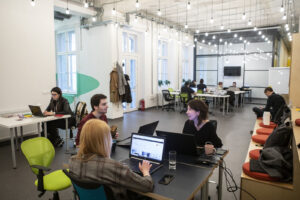
We see the same diversity at Liftoff. People working in IT, marketing, graphic design and other creative fields, as well as in consultancy, sales and a variety of knowledge-based services, work here. Some live in Budapest, whilst others are only in the city temporarily.
And this diversity is one of the most interesting aspects of co-working: people from different countries, professions and stages of life work side by side, even though they might never meet in a traditional workplace.
3. Where should you choose a co-working space in Budapest?
Location is particularly important when a digital nomad is choosing a co-working space. If someone is only spending a few weeks or months in Budapest, they usually do not want to spend a significant part of the day travelling to and from work, and it is helpful if their workplace is easily accessible from different parts of the city.
Liftoff is situated in Budapest’s District VI, close to Nyugati railway station. It is easily accessible by public transport, and many parts of central Budapest are within walking distance.
A central location is also convenient for people who want not only to work in Budapest but to experience the city as well. After work, there is no need to travel back into town from an outlying office park: restaurants, cafés, shops and city life are just minutes away. During festival season, for example around the time of Sziget, we always see more visitors who work hard during the day and party hard at night — combining business with pleasure.
4. Can you use a co-working space in Budapest for just one day?
Yes. Flexibility is one of the main advantages of co-working.
At Liftoff, you can work with a day pass, so there is no need to purchase a long-term membership. This is particularly handy for someone spending just a few days in Budapest, someone who needs a reliable place to work between trips, or anyone who simply wants to try out co-working before committing to a longer stay.
Multi-entry and longer-term co-working memberships are also available for people staying in Budapest for a longer period.
Digital nomads have very different travel patterns: some move to a new city every few days, whilst others settle in one place for a month or more. That is why flexibility can be just as important as the workspace itself.
5. What should you look for when choosing a co-working space?
Fast, reliable Wi-Fi is essential, but working remotely on a regular basis requires more than that.
A comfortable working environment, a suitable place for online meetings, and the ability to spend a full working day in one place without constantly having to look for somewhere new are all important.
At Liftoff, standing desks are available, as well as a dedicated LIFT booth for online meetings and Zoom calls. Coffee and tea are included with your coworking membership, and we can also assist members by receiving parcels and post. As we’re right in the city centre, we’re always happy to recommend reliable places to eat nearby. Our neighbourhood is part of the area known as Pest Broadway, with its theatres and international restaurant scene, and is one of the city’s liveliest districts.
The co-working space is dog-friendly, so people living in or visiting Budapest with a dog do not necessarily have to choose between work and spending time with their pet.
But there is one thing that a list of facilities cannot easily convey: the people around you whilst you work.
6. Why is community important when you work remotely?
Remote working offers a great deal of freedom, but it also has a less obvious side: it can be isolating. This can be particularly noticeable when someone moves to a new city where they know very few people.
A co-working space can therefore be more than just a workplace; it can also provide an environment that you can become part of right from your very first day.
At Liftoff, we are particularly mindful of this. Our hosts are freelancers and entrepreneurs working in a variety of fields: they include a marketer, a graphic designer, a coach, a sports professional and an author. This means that we all have first-hand experience of working independently and from any location.
For us, community is not a separate service or a networking event held once a month. It develops much more naturally as different people work in the same space day after day.
Conversations get underway; people share their professional experiences, recommend services or places in Budapest to one another, exchange ideas, and sometimes business partnerships develop.
For a digital nomad who has just arrived in Budapest, this can be particularly valuable: they do not have to start building local connections entirely on their own.
7. The role of co-working is changing as work itself changes
We believe that coworking is not just about where we work, but increasingly about how we work.
The boundaries between traditional employment, remote working, freelancing, entrepreneurship and project-based work are becoming less rigid. Over the course of a career, a person may move between several of these forms of work — and may move to different countries or cities along the way.
The spread of AI may further accelerate this change. People may be able to set up independent services or businesses that would previously have required the resources of a larger organisation. For others, AI may create a need to rethink their profession, their knowledge or the value they can create.
During these periods of transition, a co-working community can be particularly valuable. Anyone changing careers, starting a business, looking for a new professional direction or simply trying to work out what comes next does not have to face these questions alone.
They can meet people going through similar changes, find inspiration, discover potential collaborators, or simply talk to someone who understands that stage of life.
For this reason, we do not view the digital nomad lifestyle simply as “more people travelling with laptops”. It is part of a much broader shift: for more and more people, work is becoming separate from belonging to a particular company, office or even country.
8. Coworking in a former lift factory
Liftoff’s location also has links to Budapest’s industrial history.
The co-working space is situated in the building that formerly housed the Anton Freissler lift factory. The lifts for the Hungarian Parliament Building were manufactured in this factory.
Today, the same building is home to people working in digital technology, online businesses, the media, design, consultancy and other modern knowledge-based professions.
Innovation actually moved into this building long before we did. In a place where people once worked on one of the key innovative technologies of their time, digital entrepreneurs, remote workers and creative professionals now work with our own new technologies and working methods.
9. Who is coworking in Budapest for?
Coworking can be a good option for anyone working remotely in Budapest who doesn’t want to spend the whole day in a flat or a café. It’s worth giving it a go, whether you’re in the city for just a few days or settling in for several weeks or months.
A good co-working space offers more than just a desk, Wi-Fi and a place to work. It can also help you make connections more quickly in a new city, whilst still allowing you the freedom of remote working.
Frequently asked questions about Liftoff Coworking
Do I need to book in advance?
If you want to use a meeting room, yes, it’s best to book in advance. If you simply want to work at a coworking desk, there’s no need to book — just pop in, have a look around, we’ll show you the ropes, and you can decide whether you’d like to stay or move on.
Can I come for just one day?
Yes. You can use Liftoff with a day pass if you only need a place to work for one day in Budapest. Multi-entry and longer-term options are also available for longer stays.
Is there a platform for online meetings or video calls?
Yes. Liftoff has a dedicated LIFT booth for Zoom calls and online meetings.
Is Liftoff dog-friendly?
Yes, the co-working space is dog-friendly.
Where is Liftoff located?
In Budapest’s District VI, near Nyugati railway station, in a central location that is easy to reach.
Is Wi-Fi, coffee and tea available?
Yes. Fast Wi-Fi is also available, and coffee and tea are included with your coworking membership.
Are standing desks available?
Yes. Standing desks are available at Liftoff.
Can I come if I don’t speak Hungarian?
Yes. Liftoff welcomes an international co-working community, and we can assist you in English.